Crawling Through The Rubble (Part 2)
The aftermath of the tsunami and the emotional scars that remained.

Part 2
If you haven’t read the first part, I urge you to read that one first. There are many interconnected stories between this one and the last.
Most of us have experienced a traumatizing event one way or another. Life challenges us to rely on our survival instincts. The more hurdles we go through, the faster our brains come up with what we believe is the best solution at that moment. My mind, unfortunately, works differently. My survival instinct doesn’t always protect me. It seems to work best when I must look out for others.
As I continued walking past the hundreds of dead bodies laid on the road’s median strips, each step helped me regain my senses. Each step was a reminder that I was alive. Each step brought new faces to look at, and if a face was obscured, I had to take a quick look. It was truly painful to keep looking into their faces, but at the time I thought it was the most important thing to do.
Banda Aceh is a university town, and roughly 30% of its inhabitants were college students. I thought of grieving parents who would never see their children again. The least I could do was let them know if I had seen theirs.
Each step carried the hope that I wouldn’t recognize the next person. Each step felt heavier than the last.
Most of the bodies were naked. I learned later that in areas less congested than mine, the waves were much stronger, stripping people of their clothes. Some had also been taking a shower when the earthquake struck and never had time to get dressed before the tsunami hit. Because of this, for many months afterward, I couldn’t bring myself to take a shower naked.
Although it had been only about seven hours since this whole tragedy began, I was surprised by how neatly and respectfully all the bodies had been placed on the median strips. Most of the naked bodies were covered with sheets, while others were covered with banana leaves. In Islamic teaching, it is of the utmost importance to treat the deceased with respect and tenderness.
Aceh is the only one of Indonesia’s 38 provinces governed by Islamic (Sharia) law.
It is believed that Islam arrived in Indonesia during the 7th century. Because of its proximity to the Strait of Malacca, Aceh was the first place where Arab traders landed. With the teachings of Islam came literature and systems of governance, eventually leading to the formation of the Samudra Pasai Kingdom.
Because of this history, Aceh became known as the Veranda of Mecca. Equipped with knowledge and education, the Acehnese were among the last people in Indonesia to be colonized. They remain some of the most patriotic people in the country and are deeply proud of their history.
During the Soeharto regime, Aceh demanded financial autonomy and the right to govern under Islamic law. In 1959, Soeharto granted Aceh special regional status but only recognized its autonomy in matters of Islamic law. In 2002, Sharia law officially took effect, requiring women to wear head coverings.
Entertainment venues such as cinemas and concert halls were closed. Even the public swimming pool where I used to swim was shut down. Public parties disappeared, and rowdy teenagers no longer gathered openly. In my opinion, this created many unhealthy behaviors, including increased drug use and unhealthy sexual pressures, especially for young women.
I lived in a suburban neighborhood where the main street ran through the center, lined with businesses, hotels, and the general hospital. My house was located on the eighth row of side streets across from the hospital, where many homeowners rented rooms to college students. It was one of the most sought-after neighborhoods because of its proximity to both the university and downtown.
As I came closer to familiar surroundings, I met a few people I recognized. We didn’t exchange any words. We simply acknowledged each other with the kind of look that said, I’m glad to see you’re alive.
As I walked past the hospital, its parking lot was also filled with long white rows of covered bodies. I wondered what had happened to all the critically ill patients and the residents of the psychiatric ward. Not long before, I had visited the psych ward to see one of my good friends during his residency. I had been surprised by how many psychiatric patients were there, and some of them were quite violent.
Mental health was one of the most overlooked issues in Aceh. People were embarrassed by it and often hid children or family members suffering from mental illness. I even heard stories that some families chained relatives who had severe symptoms.
Later in my journey, I worked for the World Health Organization to help implement a mental health pilot project. I’ll write about that too, hopefully in the next chapter.
I crossed the street into the housing complex. Since my street was located much closer to the coast, the road was still flooded up to my chest. The narrow concrete lane was complete chaos. Cars were piled literally on top of one another. I saw bodies trapped inside some of them, and I thought to myself that I should stop worrying about my earthly possessions—namely my computer and the floppy disk that held my thesis. This is what can happen when people think of possessions over safety.
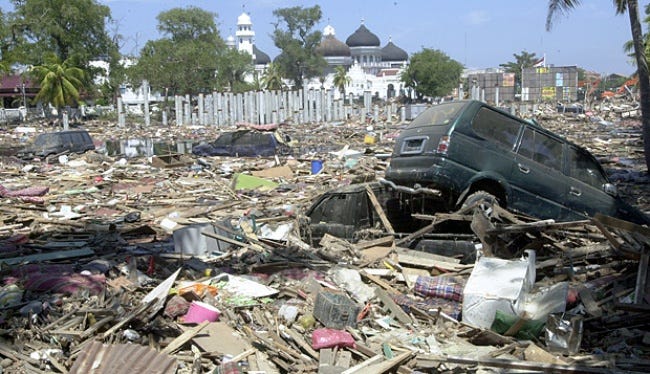
I shivered at the thought of how lucky I was that saving my belongings had never even crossed my mind while I was running. Had I stopped to grab anything, I probably would have been dead.
I had to swim to reach my house. The water was neck-high, thick, foul-smelling, and disgusting. As I moved deeper into the neighborhood, countless precious belongings floated around me—televisions, refrigerators, family portraits in wooden frames, bags of chips, soda, and gallon jugs of drinking water that must have washed out of nearby stores.
The street was eerily quiet. Nobody seemed to be around.
When I finally reached my house, my stomach sank at the sight of it. Half of the front concrete fence had been destroyed. The front door was gone. The entire house was coated in sludge from the rooftop down. Everything that had once been upstairs—beds, cupboards, sofas, clothes—was now floating in a pool of thick, ammonia-smelling sludge on the ground floor.
Ahh, I thought to myself. I’m done. Why am I even alive to see all this?
I walked to the side of the house where the garage had been. It was completely destroyed and empty. The box containing all of my childhood photographs had been stored there, and now it was gone. My parents didn’t have any of my baby pictures because I had taken them from my grandparents’ house for safekeeping. Now I had no proof of what a cute baby I was.
Next to the garage was the staircase leading to the private entrance of my room on the west side of the house. To my surprise, the stairs looked dry. I remember thinking that I really should have bought a new desk for my computer. The old one was so wobbly it could barely support its weight.
I climbed upstairs. The door to my room was wide open, just as I had left it.
The moment I caught a glimpse inside, I broke down in tears of gratitude.
It was as if nothing had happened.
The room was just as neat as I had left it. My computer sat proudly on what looked like a fake IKEA desk, still wobbling but somehow standing. My large two-door armoire stood handsomely in the corner, with two rows of perfectly folded shirts arranged in military style, just the way my grandfather had taught me. The only things that had fallen were the plastic grocery bags I had stuffed on top of the wardrobe.
I’m not sure my sanity would have survived had I not found this familiar oasis.
Then I realized I was covered in ammonia-smelling sludge, scraped up, and bleeding from the nail that had punctured my leg earlier. I went to the bathroom thinking, I’m so smart for filling the shower tub this morning.
Aceh’s water treatment system was far from ideal. During the dry season, the water we received often looked murky. My mother, who is a germophobe with sensitive skin, always taught us to mix antiseptic, such as Dettol, into the water storage tub.
Naturally, I had the biggest bottle of Dettol.
Again, I felt so smart. My mother would be proud.
After cleaning the contaminated wound on my right inner calf and stopping the bleeding, I slapped on a handful of Band-Aids—the only first aid supplies I had.
I put on my prayer clothes and began to pray. I didn’t know what I was praying for, but I knew I needed it. At some point, I must have fallen asleep sitting on the floor.
I woke to another small earthquake and realized it was almost dark; a sudden sense of fear engulfed me.
I’d better find someone to stay with me.
I went across the street to the dorm-like complex where I used to rent a room to see whether any of the younger college girls I had mentored were still around. I found three of them, and one had her boyfriend with her.
I told them to come back to my place. I had food and clean water, but we should also gather whatever snacks and drinks were floating in the streets. Even though I had enough supplies for all of us, I had no idea how long we would be stranded there.
Together, we collected quite a large stash of chips, soda, and bottled drinking water.
They were so grateful that I had clean water and clothes to share. None of us got any sleep that night. The mosques blasted prayers throughout the night, and aftershocks seemed to happen every five minutes. I can’t recall much of our conversations because we were all exhausted, but at the same time, we had to be ready to run every time the earth started shaking.
When the sun finally came up, we came up with a plan to get back to our parents, who lived about six hours away. The girls convinced me to con my way into getting a car from my ex, who was an army officer and a truly despicable person—corrupt and someone who preyed on innocent young women.
But I had only one mission in mind: I needed to get these girls home safely. I felt a strong sense of responsibility for them. Looking back, I think that was the day I found my purpose in life—to be helpful, to be the shoulder my loved ones could always lean on.
Aceh had endured almost three decades of civil war under the Soeharto regime. When he declared the region a Special Military Operations Area, thousands of troops were deployed throughout the province; unspeakable horror ensued.
As strange as it sounds, I reluctantly thought it was a blessing in disguise that the city was already filled with armed forces when the tsunami struck. Together with countless volunteers and the local police, they moved quickly. The streets were mostly cleared, although many bodies still lined the median strips, waiting for pickup trucks to transport them to the mass graves prepared for the victims.
As we walked onto the main street, I was greeted by a senior army officer who recognized me. He asked where I was headed. I told him I was going to withdraw money from an ATM and then pick up my boyfriend’s car. (He didn’t know we had broken up.)
He laughed and said, “What ATM? There’s no electricity. Nothing is working.”
Then he reached into his pocket and handed me some cash. Three hundred thousand rupiah was worth about thirty U.S. dollars back then, which was a lot of money. I was deeply touched by his generosity. I thanked him, and we continued on our way.
The city had already begun to smell, and the stench of decaying bodies lingered for months. It was suffocating, as though it were a constant reminder of the pain we had endured from losing so many loved ones.
We still had no idea how we were going to reach the car. My ex had been deployed to another province and had left it with his assistant, who lived far away—far too far for us to walk.
Then a pickup truck slowed beside us. The driver was one of my ex’s colleagues. He asked where we were going, and when I explained the situation, he willingly went out of his way to take us there.
Because I had arrived with a senior officer, the assistant reluctantly handed over the four-wheel-drive Jeep, even though he had planned to use it to evacuate himself and his friends.
Now we had a vehicle—but the fuel tank was almost empty.
We wondered how we were ever going to make it home. I stopped at three gas stations, but none of them were operating. Finally, we reached a military service station. The attendants recognized the Jeep, filled the tank without asking a single question, and refused to take any payment.
It was almost nightfall by the time we returned to my house. We packed our belongings along with all the food and drinks I had bought just a few days earlier as part of my monthly supplies. That night, we slept fitfully as aftershocks continued to shake the ground. They would continue for weeks afterward, but at first light, we headed home.
There were many conflicting reports that the roads leading in and out of the city had been destroyed, but we decided to try anyway.
As we drove east, we saw the true extent of the devastation. Village after village had been wiped out. Survivors sat silently along the roadside, looking defeated, hopeless, and confused.
We stopped at every village to share whatever food we had left.
I will never forget the expressions of pure gratitude on their faces. It touched me to my very core, and to this day, it reminds me to live with compassion and empathy. Kindness costs us so little, yet it can mean everything to someone else.
How fortunate we are to live the privileged lives we do. But I also know from experience that privilege means very little if it isn’t shared with others.
As we continued driving, we saw a convoy of ten massive military trucks carrying supplies and aid in the opposite direction. At the very end of the convoy was my father’s car.
“My father!” I screamed.
I made a very illegal U-turn, honked repeatedly, and flashed my headlights. The truck drivers answered with irritated blasts of their horns until my father finally stopped. He looked at me as though he had seen a ghost. His face was filled with shock, relief, and a thousand unanswered questions.
I ran into the middle of the road and threw my arms around him.
“Ooh, I was in so much trouble when my father found out whose car I had driven. I know, I’m so grounded.
He took my four friends and me to the only restaurant that was open. Over our meal, he told me that he had come to look for me the day before with my uncle, who had also been searching for his own children. They couldn’t find any of us. When my father saw the condition of the house I was living in, he had a sinking feeling that I hadn’t survived.
My poor mother made him promise to come back the very next day to search for me again, even if he had to look beneath the rubble.
Being home with my parents felt like a temporary distraction. The trauma ran too deep to ignore. I couldn’t close my eyes without seeing the little girl’s hair floating lifelessly in the water as I was trying to save my life and all the faces of the people who needed help. I couldn’t speak or even think about the tsunami without crying.
I wanted to go back to help, but my parents had a hard time letting me leave again. Eventually, one of my uncles introduced me to a philanthropist from New York who needed help distributing aid and running his NGO’s family reunification program, Asia Relief.
The first day I returned to Banda Aceh, the capital of Aceh, where it had all happened, I went to see my aunt’s house. What I found was devastation far beyond anything I had witnessed before. The entire street had been flattened. The only thing left on my aunt’s property was a toilet sitting on its blue marble floor—the only landmark that allowed me to recognize where her home had once stood.
Thirteen people had lived in that house, and not a single body was ever found.
And to think, I had almost spent the night there if a friend hadn’t invited me to a party.
Working on the family reunification project after the tsunami turned out to be the hardest job I’ve ever had.
I set up the office from the ground up, making sure it had everything needed to operate. I interviewed, hired, and trained fifteen college students to travel from village to village gathering information about children who had been separated from their families.
We registered every child, took their photographs, and pinned them to the walls of my office. Every day, parents came in hoping to see the face of their missing child.
One mother, in particular, will stay with me forever.
She had lost all four of her children. Half of her face had been torn apart when the wave carried her away, and she had also broken one of her arms. She walked into my office filled with hope, only to discover that none of her children’s photographs were on the wall.
As I often did during that job, I had to excuse myself and cry in the bathroom.
I could feel the depth of her love and longing for her children. The most heartbreaking part was that the sorrow she carried was so immense it could have turned the bluest sky into the darkest storm.
She taught me what it meant to long for my own children long before I ever became a mother.
In the end, we documented approximately 1,300 children. Around 70% were reunited with their families, while the remaining 30% had been orphaned. We eventually handed our database over to UNICEF, which had a long-term plan to care for and support those children.
Next, I’ll write about my journey working with United Nations agencies in tsunami- and war-torn regions, and what it truly takes to rebuild not only the land, but also its people.
Absolutely beautiful, Fattin and I hope this gets the kudos it deserves. You write beautifully about what must have been a horrible personal experience.